Opening
Ship chandling is a relationship business. Every experienced chandler will tell you that trust, reliability, and local knowledge are what win and retain fleet operator accounts. All of this is true. It is also incomplete.
The relationship matters when the fleet operator is deciding which chandlers to invite to quote. The relationship is irrelevant when the chandler receives the RFQ and the race to respond begins. At that moment, the competitive differentiator is not trust or local knowledge, it is speed. The chandler who returns an accurate, complete quote fastest wins the order. The chandlers who respond after the fleet operator has already committed are out of the running regardless of their relationship history.
This is the dynamic that shapes the commercial reality of ship chandling operations. And it is the dynamic that Tidal's RFQ automation was built to change.
Why It Matters
The ship chandling market serves over 50,000 port calls per year globally. The typical RFQ-to-decision cycle runs on a timeline set by the vessel's port schedule, a vessel arriving with 18 hours in port cannot wait two days for quote comparison. In practice, fleet operators send RFQs and make selection decisions within hours, not days.
A chandler processing RFQs manually, reading the requisition, checking stock, pricing line items, preparing a quote response, can handle a limited number of concurrent RFQs before turnaround time degrades. At peak periods, when multiple vessels are in port or approaching simultaneously, manual processing creates a queue. The orders at the back of the queue go to whoever responded while the first chandler was still working through the previous one.
Staff addition is the traditional solution: more people processing RFQs means more capacity. It also means more payroll, more management overhead, and a workforce that sits idle during slow periods and is overwhelmed during peaks. The economics of staffing for peak demand are poor in any business. In chandling, where port call volumes are irregular and seasonally variable, they are particularly poor.
The RFQ Problem, Precisely
A typical RFQ received by a chandler contains 50-200 line items, each requiring:
- Product identification (matching the requisition to the chandler's catalogue, complicated when RFQs use free-text descriptions rather than IMPA codes)
- Stock availability check
- Price retrieval and margin application
- Substitution identification if a requested item is out of stock
- Quote document preparation in the format the fleet operator expects
For a 100-line-item RFQ processed manually, this takes a skilled chandler's team 45-120 minutes. For a chandler receiving 10 simultaneous RFQs during a busy port period, the queue mathematically cannot clear before some fleet operators have already committed elsewhere.
The problem is not the chandler's competence. It is the workflow. Manual RFQ processing has a throughput ceiling that no amount of skill improves, only speed does, and speed at manual processes has limits.
What Tidal Does
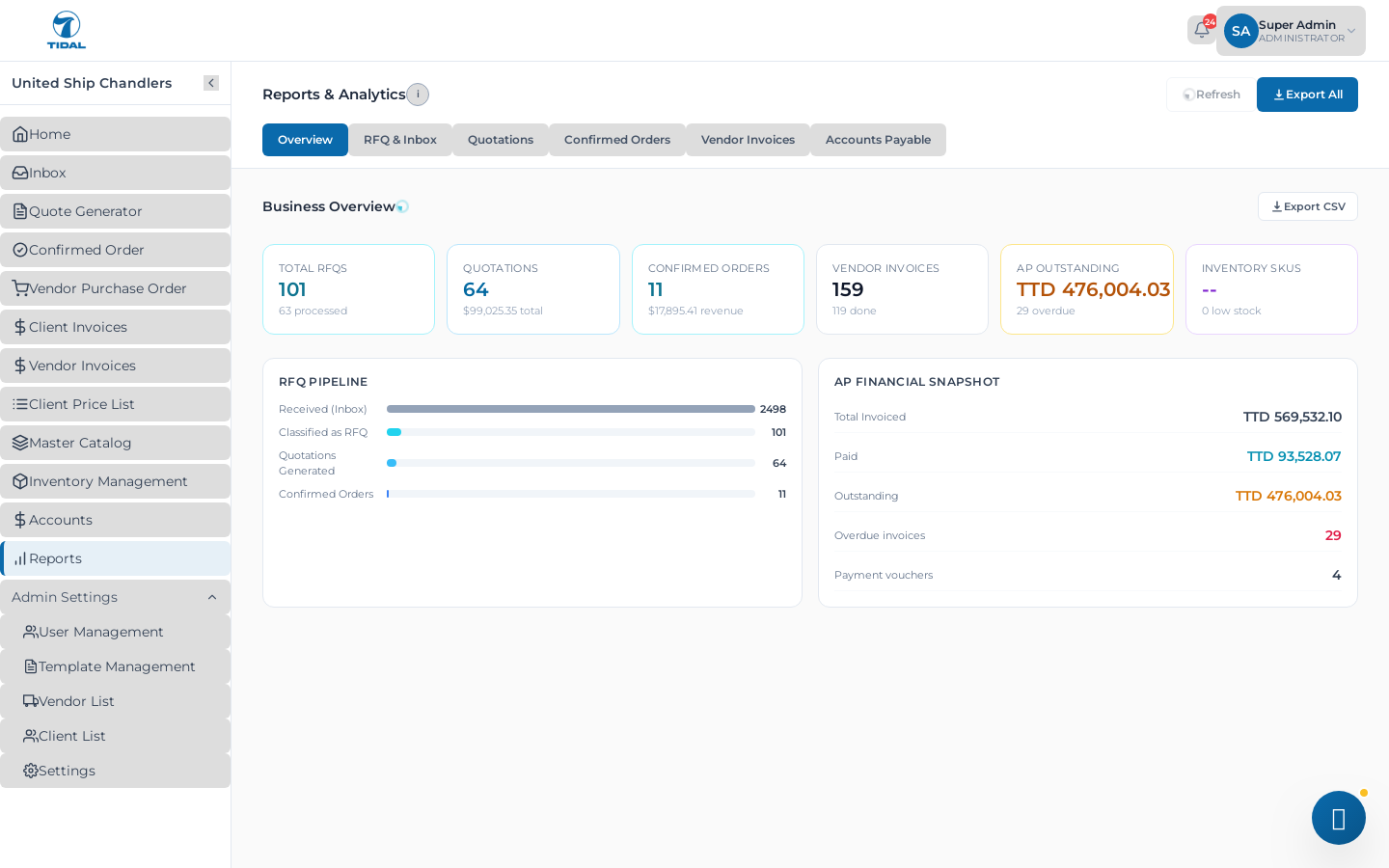
Tidal's ship chandling software automates the chandler-side of the RFQ workflow. An RFQ arriving by email or through the Tidal platform is parsed automatically, line items extracted, IMPA codes matched where present, free-text descriptions matched to the catalogue using AI-assisted product recognition. Stock availability is checked against the chandler's inventory system in real time. Pricing is applied from the configured price list with margin rules.
The output is a draft quote, pre-populated with all available items, flagged substitutions highlighted for review, and unavailable items marked. The chandler reviews the draft, approves or adjusts, and sends, in minutes rather than hours.
For a chandler handling peak RFQ volume, the operational difference is significant:
| Scenario | Manual Processing | With Tidal |
|---|---|---|
| Single 100-item RFQ | 60-90 minutes | 5-10 minutes (review only) |
| 5 concurrent RFQs | 5-7 hours (sequential) | 30-50 minutes (parallel) |
| 10 concurrent RFQs | Breaks down; some missed | Still manageable |
The speed improvement is not the only benefit. Accuracy improves because the system does not make the arithmetic errors that occur in manual price calculation across 100+ line items. Substitution handling is systematic, every out-of-stock item generates an explicit substitution notification rather than being quietly substituted with no notification to the fleet operator.
The fleet operator receives a complete, accurately priced, clearly structured quote, first. The relationship advantage is preserved. The speed disadvantage is eliminated.
Business Impact
A chandler using Tidal does not just win more RFQs by responding faster. The operational leverage changes the economics of growth. Without Tidal, adding 30% more RFQ volume requires roughly 30% more staff to maintain response times. With Tidal, adding 30% more RFQ volume requires minimal additional staff, the automation scales, the headcount does not.
For a chandler evaluating expansion into additional ports, a strategic priority given the Red Sea rerouting's impact on which ports receive vessel traffic, the ability to handle higher RFQ volumes without proportional headcount growth is the difference between viable and unviable expansion economics.
Act On This Now
Map your current RFQ response time. For the last 20 RFQs you received: how long from receipt to quote sent? How many were you first to respond? How many resulted in an order? What is the correlation between response time and win rate?
Most chandlers who do this analysis find a clear pattern: win rates are significantly higher when response time is under two hours, and significantly lower when response time exceeds four hours. The data makes the case that the investment in faster processing has a direct revenue return.
Key Takeaways
- Speed-to-quote is the primary competitive differentiator in ship chandling, the first complete, accurate quote wins.
- Manual RFQ processing creates a throughput ceiling that peaks processing capacity cannot clear.
- Tidal automates intake, catalogue matching, pricing, and draft quote generation, reducing chandler quote time from hours to minutes.
- The accuracy improvement is as significant as the speed improvement, manual errors in 100+ item quotes are common and create disputes.
- The operational leverage changes growth economics: more volume without proportional headcount.
FAQ
Q1. What if our RFQs come in many different formats, some IMPA, some free text, some Excel?
Tidal's intake handling is format-agnostic. IMPA-coded RFQs match directly to the catalogue. Free-text descriptions go through AI-assisted product recognition. Excel attachments are parsed and line items extracted automatically. The goal is to accept whatever the fleet operator sends and convert it to a structured, processable format on your side.
Q2. How does Tidal handle items not in our catalogue?
Out-of-catalogue items are flagged for manual review with a recommendation for the closest available alternative. The chandler reviews and confirms the substitution before it goes into the draft quote. This ensures the fleet operator always receives an explicit substitution notification rather than a surprise.
Q3. Does Tidal integrate with our existing inventory system?
Tidal supports integration with common chandler inventory and ERP systems for real-time stock availability checking. Integrations are configured during onboarding, contact us for specifics on your current system.
Ready to respond first, every time? Request a Tidal demo for chandlers and see the RFQ automation in action. Request Demo →