 Customer Login
Opening
A fleet superintendent managing 15 vessels has a procurement system. It is their inbox. Every RFQ they have sent in the past three years is in there somewhere. Every quote they have received. Every order confirmation. Every dispute. Every substitution notification, if the chandler remembered to send one.
This inbox has no search capability that surfaces "what did we pay for provisions at Las Palmas in Q3 last year." It has no way to compare the pricing from three chandlers at the same port across five port calls. It has no record of which chandlers consistently substituted items without notification. It has no audit trail that a finance team can review. It has no visibility for anyone other than the superintendent whose inbox it is, not the fleet manager, not the procurement director, not the accounts team.
When that superintendent leaves the company, takes holiday, or falls ill, their institutional procurement knowledge is inaccessible. The new superintendent or covering colleague starts from a blank state, rebuilding relationships and benchmarks that took years to accumulate.
This is not a hypothetical. This is the standard operating model for vessel procurement across the maritime industry.
Why It Matters
The scale of what runs through the superintendent's inbox is significant. A fleet of 15 vessels making port calls every 10-14 days generates approximately 400 port calls per year. Each port call involves an RFQ, multiple quote responses, a selection decision, an order confirmation, a delivery, and often a post-delivery communication about substitutions, short deliveries, or quality issues.
That is 400+ procurement cycles per year, each generating multiple email exchanges, the cumulative total of which represents millions of dollars in annual spend decisions, none of it systematically recorded, searchable, or available for analysis.
The absence of this data has three direct consequences:
No benchmarking. A fleet operator who has been calling at Singapore for five years cannot easily answer "are we paying more for provisions now than two years ago, controlling for commodity price changes?" The data exists, scattered across email threads and PDF attachments, but is not retrievable in any useful form.
No supplier performance data. Which chandlers at which ports consistently deliver what was ordered? Which ones substitute without notification? Which ones have delivery accuracy above 95%? Without a systematic record, supplier selection continues to be based on relationship and memory rather than data.
No portfolio view. A procurement director responsible for a fleet cannot see aggregate spend across vessels, ports, and categories without requesting reports from each superintendent and manually consolidating them. This is a monthly exercise at best, not a real-time visibility tool.
The Inbox as Procurement System
The email inbox has one genuine advantage as a procurement tool: it requires no implementation, no training, and no change management. Everyone already uses email. The onboarding cost is zero.
The operational cost is what accumulates over time. The superintendent who spends two hours comparing three quotes for a 120-item requisition, manually opening each attachment and building a comparison spreadsheet, is spending time that could not be recovered from the inbox process, but that is entirely recoverable with a structured procurement tool.
The fleet manager who wants visibility into what the fleet spent on provisions last month cannot get it from a collection of individual superintendents' inboxes. The finance team that wants to audit procurement decisions does not have the access or the format to review email threads. The risk manager who wants to verify that suppliers are meeting compliance standards has no systematic data to review.
What Tidal Provides
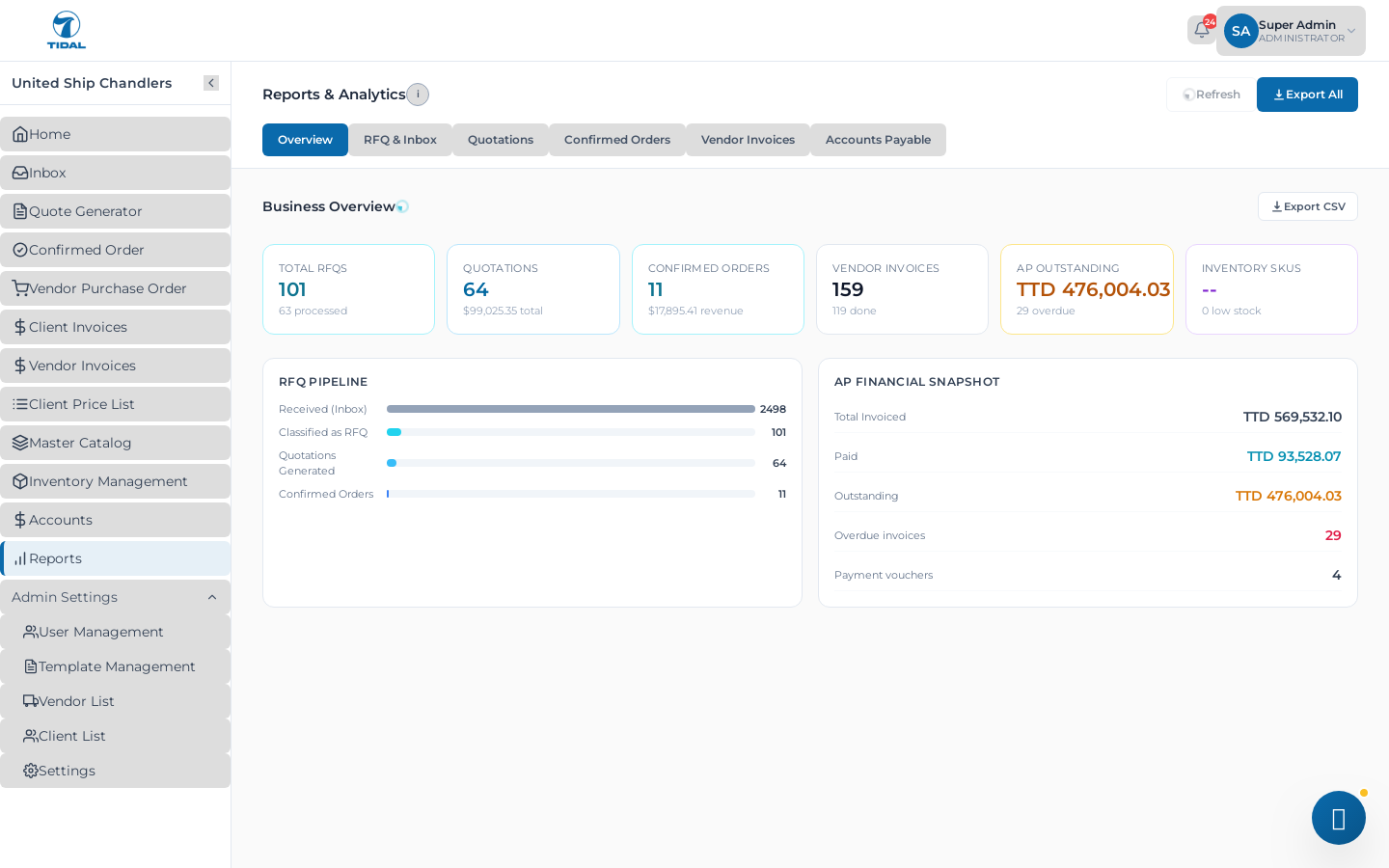
Tidal gives fleet operators a structured procurement environment where every requisition, quote, order, and delivery is recorded in a shared, searchable record.
Requisition dispatch. A port call requisition is created in Tidal and dispatched to selected chandlers simultaneously. Each chandler receives a structured request, not a PDF attachment, but a directly processable list of items, and responds through the platform.
Quote comparison. Incoming quotes appear in a standardised comparison view. Same line items, same format, side by side. The superintendent sees all quotes simultaneously rather than opening three separate email attachments. Substituted items are highlighted automatically. Missing items are flagged.
Order confirmation and delivery tracking. The confirmed order is recorded in Tidal with the selected chandler, the agreed items, and the delivery schedule. Substitutions at delivery are recorded and require confirmation. The complete order history, what was requested, what was quoted, what was ordered, what was delivered, is in one record.
Supplier performance over time. Tidal accumulates delivery accuracy, substitution rates, pricing trends, and response time data across every order from every chandler. A superintendent can see, at a glance, which chandlers at a port have the strongest historical performance, not from memory, from data.
Fleet-wide visibility. The procurement director sees aggregate spend across all vessels, all ports, and all categories in real time. The finance team can pull an audit trail for any procurement decision. The risk team can review supplier compliance status.
Business Impact
The recoverable cost of moving from inbox-based to platform-based procurement falls into three categories:
Time savings: A superintendent who spends 2 hours per port call on manual quote comparison, across 400 port calls per year, is spending 800 hours annually on manual comparison. Platform-based comparison with standardised quote formats reduces this to 20-30 minutes per call, recovering 600+ superintendent hours annually for a 15-vessel fleet.
Pricing improvement through benchmarking: Fleet operators who implement systematic benchmarking across chandlers at the same port typically identify pricing differences of 5-15% between the highest and lowest compliant quotes. Systematic selection of the best-priced compliant option on every order, against an accurate benchmark, produces measurable savings across a full year's chandling spend.
Dispute reduction: Substitution disputes, the single most common source of post-delivery friction between fleet operators and chandlers, are significantly reduced when substitution handling is explicit and confirmed before delivery rather than discovered after.
Act On This Now
Pull the last three months of chandling spend for your fleet. Not the total, the detail. How many orders? How many chandlers? What categories? What was the spend at each port?
For most fleet operators, this exercise takes several days of manual extraction from email histories. The inability to answer this question quickly is itself the diagnostic. A procurement function that cannot produce its own spend data without multi-day manual effort is operating without visibility into one of its largest cost categories.
Key Takeaways
- Fleet operator procurement lives in superintendents' personal inboxes, no shared record, no searchability, no audit trail, no portfolio view.
- The institutional knowledge that makes effective procurement possible walks out the door when a superintendent leaves.
- Tidal moves procurement onto a platform where requisitions, quotes, orders, and supplier performance are recorded and available to everyone who needs them.
- Time savings from standardised quote comparison are significant, 600+ superintendent hours annually for a 15-vessel fleet.
- Systematic benchmarking, made possible by a structured procurement record, typically identifies 5-15% pricing improvement opportunities on annual chandling spend.
FAQ
Q1. We have established chandler relationships at our main ports. Will Tidal disrupt those?
No. Your established chandlers can be invited to your Tidal workspace and continue to supply your vessels through the platform. The relationship is maintained; the workflow is structured. You can continue working exclusively with your existing suppliers while gaining the visibility and benchmarking capability that the email workflow lacks.
Q2. How long does it take to get a fleet onboarded on Tidal?
Initial onboarding, connecting your fleet's vessels, inviting your procurement team, and inviting your established chandlers to the platform, typically takes 1-2 weeks depending on fleet size and the number of ports in your regular rotation.
Q3. Can Tidal integrate with our fleet management software?
Tidal integrates with common fleet management and ERP systems to import vessel schedules, port call data, and approved supplier lists. Contact us for specifics on your current system configuration.
Move your vessel procurement off email and onto a platform where every decision is recorded. Request a Tidal demo for fleet operators. Request Demo →