 Customer Login
Opening
The maritime digital transformation numbers are real. The global maritime digitisation market stands at $165 billion in 2025, growing at 11.5% annually. A Wärtsilä survey found 66% of shipping companies have started their digital transformation, with 69% actively exploring digital solutions. The EU's Emissions Trading System, extended to maritime transport in 2024, is driving investment in voyage optimisation and carbon monitoring systems. The Marine IoT market, sensors monitoring hull integrity, engine performance, fuel consumption, is estimated at $4.85 billion in 2025 and growing toward $12 billion by 2032.
The picture is of an industry in genuine technological transition. Fast in some areas, slow in others, but moving.
The exception is procurement. Ask a fleet superintendent how they source ship stores and provisions for a port call, and the answer is almost invariably the same: they send an email. They receive quotes by email. They compare quotes in a spreadsheet. They confirm orders by email. They resolve disputes by email. The tools are identical to what they used in 2005.
Why It Matters
Procurement is not a peripheral function in maritime operations, it is a core cost driver. The supplies that go on a vessel at each port call, provisions, deck stores, engine room supplies, safety equipment, spare parts, are essential to operational continuity. A vessel that departs port without the correct stores risks costly emergency sourcing at sea or at the next port. A vessel that departs with incorrect or substituted items risks operational failures.
The direct cost of ship chandling for a mid-size fleet operating globally runs into millions annually. The indirect cost, staff time spent on manual procurement, errors from email-based communication, disputes from undisclosed substitutions, inability to benchmark pricing across ports and suppliers, is harder to quantify but real.
In any other industry with comparable spend volumes, the procurement workflow would have been digitised and automated years ago. Automotive manufacturers use supplier portals. Healthcare systems use GPO platforms. Retail chains use centralised purchasing systems. Maritime procurement still uses email.
What Changed Everywhere Else
Voyage optimisation: AI platforms analyse weather, current, congestion, and emissions requirements simultaneously to recommend optimal routes. Operators who implement these systems reduce fuel costs by 3-8% annually. Digital, AI-driven, measurably valuable.
Predictive maintenance: IoT sensors monitor engine and hull condition continuously, flagging anomalies before they become failures. Unplanned downtime costs $50,000 to $1 million per day depending on vessel type. Predictive systems reduce this risk materially. Digital, IoT-driven, measurably valuable.
Compliance reporting: The EU ETS requires carbon reporting. CII (Carbon Intensity Indicator) ratings affect vessel commercial value and operational flexibility. Digital compliance platforms capture and submit the required data automatically. Digital, regulatory-driven, not optional.
Crew management: Crew scheduling, certification tracking, training compliance, payroll, all managed through digital platforms that maintain regulatory compliance across global flag state requirements.
The exception, procurement: Still on email, still on PDFs, still on spreadsheets. The argument for this exception is usually "relationships", that chandling is a relationship business where the personal trust between a superintendent and a port chandler is the primary factor in supplier selection.
This is partially true and wholly insufficient. Relationships are valuable. Relationships built on top of a structured digital procurement workflow, where the history of quotes, orders, substitutions, and delivery performance is recorded and available, are more valuable than relationships built entirely on informal email chains where institutional knowledge walks out the door when the superintendent changes roles.
The Procurement Exception
The procurement gap exists for structural reasons that are understandable and solvable. Maritime procurement is fragmented by geography, a chandler who knows Singapore Harbour may have no presence in Rotterdam or Durban. Standardisation of product catalogues (IMPA codes help, but implementation is inconsistent) has been slow. And the bilateral nature of the marketplace, chandlers and fleet operators both need to adopt the platform for it to work, creates a classic chicken-and-egg problem.
These are real barriers, not imaginary ones. They explain why the procurement gap persists. They do not explain why it is acceptable, or why it should continue to persist given that the tools to solve it exist and the market is demonstrably willing to pay for operational efficiency gains in every other function.
Business Impact
The quantifiable cost of manual maritime procurement, across a fleet of 20 vessels and 300+ port calls per year:
- Superintendent time on manual quote comparison: 2-4 hours per port call × 300 calls = 600-1,200 hours annually
- Quote comparison errors: Estimated 3-5% of orders affected by manual comparison errors (wrong item selected, missed line items)
- Substitution disputes: 15-25% of orders involve at least one undisclosed substitution (from the E-ShipSupply research)
- Absence of benchmarking data: No ability to systematically compare pricing across chandlers at the same port, or the same chandler over time
Each of these represents a recoverable cost. The total across a mid-size fleet is material, and it is not being recovered because the procurement function remains outside the digital transformation that is touching every other part of maritime operations.
What Comes Next
The procurement gap will close. The question is the timeline and who closes it. Digital platforms purpose-built for maritime procurement, handling both the chandler-side (RFQ processing, quote management, inventory) and the fleet operator-side (requisition dispatch, quote comparison, order confirmation, performance tracking), are emerging. The Red Sea crisis, by forcing fleet operators into unfamiliar ports and destabilising established chandler relationships, has accelerated the recognition that email-based procurement is a fragility, not a feature.
Key Takeaways
- Maritime digitisation is real and accelerating, voyage optimisation, predictive maintenance, compliance reporting are all active investment areas.
- Procurement is the conspicuous exception: the RFQ-to-order workflow remains primarily email-based despite being a major cost driver.
- The cost of manual procurement, superintendent time, comparison errors, substitution disputes, benchmarking absence, is quantifiable and material.
- The structural barriers to procurement digitisation (geography, standardisation, bilateral adoption) are real but solvable.
- The Red Sea crisis has accelerated the case for digital procurement by demonstrating that email-based supplier relationships are fragile under rerouting pressure.
FAQ
Q1. Why hasn't someone already built a maritime procurement marketplace?
Several have tried, at different levels of maturity. The challenge is the bilateral adoption problem: a platform is only useful if both chandlers and fleet operators are on it. Platforms that have succeeded in maritime have generally solved this by starting on one side of the marketplace and building adoption incrementally. The ship chandling market's geographic fragmentation makes this harder than an equivalent marketplace in a single-geography industry.
Q2. How do IMPA codes fit into digital procurement?
IMPA codes provide a product standardisation layer that makes machine-readable RFQs possible. A requisition that specifies items by IMPA code rather than free-text description can be processed much faster by a chandler, they know exactly what is being requested and can price it directly against their stock. Digital procurement platforms that support IMPA code lookup and matching are the prerequisite for genuinely efficient maritime procurement.
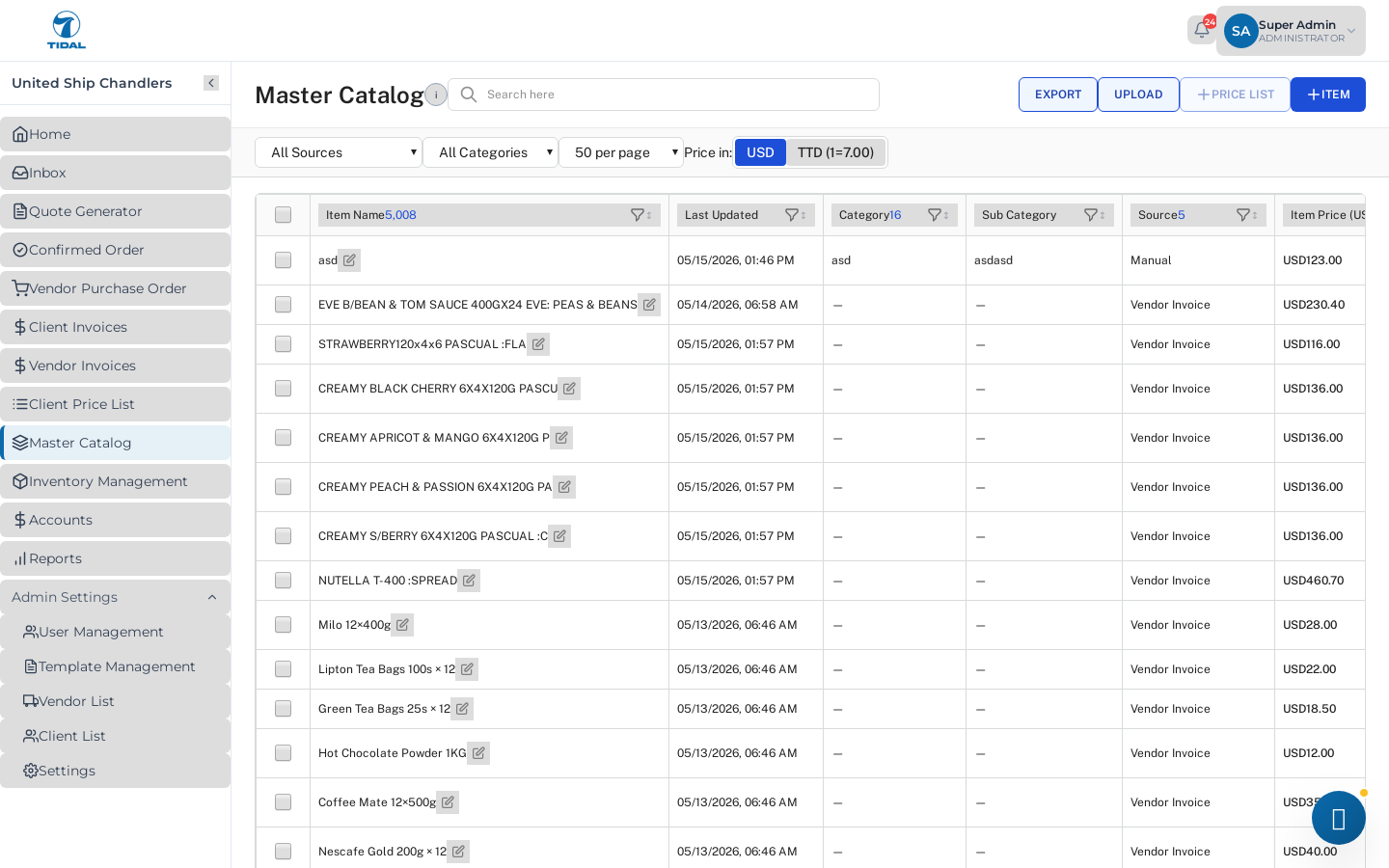
Tidal is building the procurement platform maritime is missing. Both sides of the marketplace, in one structured system. Request a Demo →